Search for Posts, Maps, and Topics
According to Encyclopædia Britannica, AUSTRALIA’s population in the year 2020 is about __________ and is ranked 52nd among populations of the whole world’s countries, dependencies, and territories. The correct answer is listed further below!
A — 5,743,000
B — 25,743,000
C — 255,743,000
ANSWER
B — 25,743,000
You may know about Tasmania, a sharktooth shaped island encompassing an area of 68,401 sq. kilometers and 26,410 sq. miles in southeastern AUSTRALIA. However, are you familiar with the over 300 smaller islands surrounding Tasmania? If not, here are some of those islands: Badger, Bruny, Cape Barren, Clarke, Curtis, De Witt, Deal, Flinders, Hogan, Hunter, King, Maatsuyker, Maria, Robbins, Schouten, Three Hummock, Walker, and Waterhouse. Much smaller than Tasmania, the largest island of the minor islands is Flinders with an area of 1,367 sq. kilometers and 527.8 sq. miles. A majority of the islands surrounding Tasmania are not inhabited by people, including Hogan, Hunter, Maria, and Waterhouse. Some but not all of the larger inhabited islands contain communities and towns. These include Adventure Bay, Alonnah, Dennes Point, Great Bay, Lunawanna, North Bruny, and South Bruny on Bruny island; Emita, Lady Barron, Loccota, Whitemark, and Wingaroo on Flinders island; and Currie, Egg Harbor, Grassy, Loorana, and Naracoopa on King island.

The following produce and materials are major exports of AUSTRALIA: alumina (aluminum oxide), automobiles, barley, bauxite, coal, diamonds, gold, iron ore, machinery, meat, mineral sands, natural gas, nickel, petroleum, rare earth elements, silver, sugarcane, transportation equipment, tropical fruits, tungsten, vehicles, wool, and zinc. According to the International Monetary Fund (data.imf.org), countries and territories buying and importing most of those exports in 2016 include China (top importer), Japan, the United States, South Korea, India, New Zealand, the United Kingdom, Thailand, Taiwan, Singapore, Malaysia, Indonesia, Germany, Hong Kong, Vietnam, the United Arab Emirates, the Netherlands, France, Papua New Guinea, and Italy.
Yesterday on April 25th, AUSTRALIA and NEW ZEALAND celebrated the 102nd anniversary of Anzac Day. This annual day commemorates the service of all veterans who served and are serving in wars and peacekeeping missions. By the way, ANZAC is an acronym for Australian and New Zealand Army Corps. Australians and New Zealanders (Kiwis) first observed the holiday in 1916 — in order to memorialize binational troops arriving at Gallipoli (TURKEY) to fight in World War I against the Ottoman Empire.
The IUCN Red List of Threatened Species™ for Norfolk Island in the South Pacific Ocean (south of New Caledonia) lists 9 extinct species, 2 critically endangered species, and 5 endangered species. Some extinct species are as follows: the Norfolk Kaka bird and Tasman (Norfolk Island) Starling bird. The Australian island territory's two critically endangered species are the Paratya norfolkensis shrimp (endemic to Norfolk Island creeks) and White-Breasted Silvereye bird. These five species are endangered: Advena charon land snail, Dolapex amiculus land snail, Indian Yellow-Nosed Albatross bird, Lutilodix imitratrix land snail, and Mathewsoconcha belli land snail.
The IUCN Red List of Threatened Species™ for Christmas Island in the Indian Ocean lists two extinct species (Christmas Island Burrowing Rat and Maclear's Rat), four critically endangered species, and five endangered species. Critically endangered species on Christmas Island are as follows: Andrews' Frigatebird, Christmas Island Pipistrelle bat, Christmas Island Shrew, and Christmas Island Whiptail Skink. The Australian island territory's five endangered species are the Abbott's Booby bird, Barau's Petrel bird, Golden Sandfish sea cucumber, Green Turtle, and Undulate Wrasse fish.
At the top of northeastern AUSTRALIA, Cape York Peninsula extends northward towards Papua New Guinea and is surrounded by water bodies at the confluence of the Indian Ocean and Pacific Ocean. This peninsula in Queensland state is east of the Gulf of Carpentaria, south of Endeavour Strait and the larger Torres Strait, and west of the Coral Sea and Great Barrier Reef.
Preserving Nature and Native Culture in Northeastern Australia
The Great Barrier Reef Marine Park attempts to preserve the habitats of coral reefs and aquatic species. The park extends from Cape York at the very top of Cape York Peninsula to the south at a distance of over 1,500 kilometers, stopping north of Bundaberg city. Back to land, Cape York Peninsula boasts plenty of national parks, such as Archer Bend NP, Iron Range NP, Jardine NP, and Rokeby-Croll Creek NP. The Aborigine natives mainly live in several reserves including Aurukun Aboriginal Land, Cape York Abor. Reserve, Lockhart River AL, Mapoon AR, and Weipa AR.
The long Great Dividing Range stretches south of Cape York Peninsula, and several peaks on the peninsula include Mount Carter (~670 meters), Mt. Ryan (518 m), and Mt. Tozer (545 m). The Endeavour Strait north of the peninsula is south of Prince of Wales island and several smaller islands. North of these islands and south of the Torres Strait near Papua New Guinea are dozens more islands – the largest being Badu and Moa. Finally, towns and communities on Cape York Peninsula include Cape York, Coen, Iron Range, Lockhart River aboriginal community, Mapoon Mission Station, Weipa, and Weipa South.
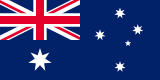
The iconic 1:2 ratio flag of AUSTRALIA, the only country that is a continent, was first adopted on September 3rd, 1901. This was about eight months after Australia's federation and independence from the United Kingdom on New Year's Day 1901. Every year, Australia's National Flag Day is celebrated on September 3rd. Starting more than two centuries ago, Australia's former flag was Great Britain's Union Jack flag in the time periods 1801-23 and 1854-1901; this is because Australia was a colony of Great Britain beginning in the late 1700s. According to Vexilla Mundi, the flags in-between the two time periods consisted of the Union Jack in the top left corner, red narrow vertical and horizontal stripes crossing each other in 1823-31 followed by dark blue stripes in 1831-54, and four eight-pointed stars in 1823-31 followed by five stars in 1831-54. Two flags in the 1901-8 time period featured a six-pointed Star of David below the Union Jack. The current dark blue flag's seven-pointed Commonwealth Star symbolizes Australia's 1901 federation. The Union Jack is still in the top-left corner, and there are five white stars of the Southern Cross constellation (Crux) to the right of it. The Crux post on my Little Astronomy Blog reveals a portion of the significance Crux has in the Southern Hemisphere sky; it is a small constellation outshining many constellations with its five brightest stars.
Australia flag image credit: Flagpedia.net
As of June 30th, 2014, the IUCN Red List of Threatened Species™ lists over 200 endangered and over 100 critically endangered species in AUSTRALIA (learn more about Australia with my post). The Red List declares 37 species as extinct, including different types of arachnids, emus (Kangaroo Island Emu and King Island Emu), frogs (Eungella Gastric-Brooding Frog, Southern Day Frog, and Southern Platypus Frog), mice (including the Blue-Grey Mouse, Darling Downs Hopping Mouse, and Short-Tailed Hopping Mouse), and snails. There are also many marsupial species on the extinction list, including the Thylacine, the Yallara, bandicoots (Desert Bandicoot and Pig-Footed Bandicoot), and wallabies (Central Hare-Wallaby, Eastern Hare-Wallaby, and Toolache Wallaby). Many of those species were recorded extinct even more than a hundred years ago; for example, the Short-Tailed Hopping Mouse was extinct since 1896.
On May 22nd, the SUNY-ESF Institute for Species Exploration announced ten recently discovered species that topped its list, ranging from a one-celled organism to a much larger tree species (SUNY stands for State University of New York and ESF stands for Environmental Science and Forestry). The Olinguito mammal (in the raccoon family) lives in the Andes mountains of Colombia and Ecuador. Kaweesak's Dragon Tree was discovered in Loei and Lop Buri provinces in Thailand. Named after the Antarctic Geological Drilling Program (ANDRILL), the ice-dwelling Andrill Anemone were discovered under a glacier on Antarctica's Ross Ice Shelf. Aptly named for its appearance, tiny Skeleton Shrimp were found in a cave on Santa Catalina island in California, USA.
The Orange Penicillium fungus was discovered in Tunisia soil, while scientists found a type of one-celled Amoeboid Protist in underwater caves in the Mediterranean Sea, specifically off the coast of Spain. Northeastern Australia is a habitat for the rare Leaf-Tailed Gecko. Clean Room Microbes have an interesting discovery story. They were discovered in spacecraft assembly clean rooms, where most microscopic organisms cannot survive, in the USA (Florida) and French Guiana. Another interesting small organism is the Tinkerbell Fairyfly, a parasitic wasp discovered in Costa Rica. Finally, eyeless Domed Land Snails certainly have a ghostly appearance with their translucent shells. They were found in western Croatia's Lukina Jama-Trojama caves.
Along AUSTRALIA's eastern coast lies the Great Dividing Range, an extensive mountain range that stretches from Cape York Peninsula in the north all the way down to the state of VICTORIA. Most of Australia's major cities, including Brisbane, Sydney, and Canberra (Australia's capital), are situated off the eastern coast; the Great Barrier Reef, the world's largest habitat for coral reefs, lies immediately northeast of Australia. Finally, the highest mountain — Mount Kosciuszko (7,310 ft and 2,228 m) — towers east of Victoria and south of Canberra.
AUSTRALIA has 8 states/territories on the mainland. They are... Australian Capital Territory, Jervis Bay Territory, New South Wales, Northern Territory, Queensland, South Australia, Tasmania, Victoria, and Western Australia. Even though Tasmania isn't on the mainland (it's an island), it is considered an Australian state.
Here are the 10 largest countries in area:
1) Russia
2) Canada
3 or 4) * United States of America
3 or 4) * China
5) Brazil
6) Australia
7) India
8) Argentina
9) Kazakhstan
10) Algeria — was formerly Sudan until South Sudan separated from Sudan
*** Visit this wikipedia page for the whole list of countries by area.
* The areas of the USA and China may vary depending on what is included and excluded from the total area; both total areas are similar.
Christmas Island is an Australian territory located in the Indian Ocean to the northwest of Australia and southwest of Indonesia. The island is part of Asia rather than the continent of Oceania but is not far from the Australian tectonic plate — and therefore not far from Oceania. Captain William Mynors named it Christmas Island in 1643 because he sailed passed it on Christmas day! The capital and largest town is Flying Fish Cove, also known as The Settlement and located along the northern coast. The official language is English.
 AUSTRALIA is a continent and country located between the Indian Ocean to the west and the South Pacific Ocean to the east. Australia's nearby countries include East Timor (Timor-Leste), Indonesia, New Zealand, and Papua New Guinea. Between the cities of Darwin and Cairns is the Gulf of Carpentaria. The Great Australian Bight takes a bite out of southern Australia! Below mainland Australia is the island of Tasmania, whose capital is Hobart. The largest town in Australia, Sydney, has a population of 4,500,000. The national capital is Canberra. According to Encyclopædia Britannica, Australia’s population in the year 2020 is about 25,743,000 and is ranked 52nd among populations of the whole world’s countries, dependencies, and territories. The currency is the Australian Dollar, and its ISO 4217 currency code is AUD. For some basics about Lake Eyre in southern Australia, visit my Lake Eyre post.
 Lake Eyre, located in AUSTRALIA, is the lowest point in Australia and Oceania. It is around 49 feet below sea level and is located in the large Lake Eyre Basin. This lake is located in the northeast in the province of South Australia. Typically a dry or extremely saline lake, Lake Eyre is sometimes known as Australia's largest lake when it is water-filled. At least one species — the Eyrean Grasswren bird — is named after Lake Eyre. By the way, Canberra — not Sydney, contrary to popular belief — serves as the national capital of Australia!
Blog Content
● The author of this GeoFact of the Day Blog creates and curates original, authentic content and posts information based on established facts. Blog posts are not generated by artificial intelligence (AI) but published by the author.
● Content and image graphics from other sources are properly credited. Many geography facts are well-established and therefore do not belong to any one source, but occasionally a fact requires attribution/credit if it is unique and hard-to-find — for example, facts found from specific cultural, anthropological, geological, and scientific (etc.) research.
● I do not copy and paste from other websites. Therefore, all posts are original but may sometimes include information, links, and/or images from credited external sources. To use a GeoFact of the Day Blog image for your website or project, write a comment below a post — then I may approve your request.
● Feel free to offer comments, suggestions, and compliments on any post or page! You can be anonymous. Spam comments with non-relevant links will be deleted.
● Thanks for your loyal readership on the educational and reliable GeoFact of the Day Blog, in existence since 2008!


