
Informative geography facts about our wonderful planet, detailed and easy-to-read maps, and various topics about each country! I am pleased to update my blog as a passion project and do not generate content with AI.

Showing posts with label Togo. Show all posts
Showing posts with label Togo. Show all posts
Thursday, January 26, 2023
January 2023 Africa Trivia Quiz
Happy New Year! January 2023’s continental quiz is a continuation of the Africa GeoQuiz in December of last year. After testing your African trivia prowess, you can further test your geographic knowledge (↗) with other geography quizzes from GeoFact of the Day. The answers are listed below; enjoy and good luck!
1) Fill in the blank: _________ from desert land in present-day MALI was once so highly prized that an ounce of this resource carried the same value as an ounce of gold!
A — sand
B — salt
C — pepper
2) True or false: the Olduvai Gorge, Serengeti grassland region, and Mount Kilimanjaro are all notable landscape features of northern UGANDA.
3) The naming (etymology) of BURKINA FASO translates in English to “land of the honest men” as well as “land of the _________.”
A — liars
B — incorruptible
C — brazen
4) Fill in the blank: tucked in the northeast corner of EQUATORIAL GUINEA, Ebebiyín is a “corner city” of about 36,000 residents near _________ as well as GABON.
A — CAMEROON
B — DJIBOUTI
C — LESOTHO
D — MADAGASCAR
5) MAURITIUS is one of the first countries around the globe to convert a relatively unconventional material to generate electricity. Steam turbines powered by this crop produce up to one fifth (1/5) of the island’s electricity during the annual harvest season! Which crop is especially used in Mauritius for energy needs?
A — broccoli
B — sugarcane
C — plantains
D — guava, mangoes, and papaya
6) True or false: Lake Togo gave the country of TOGO its name. Togo is derived from the Ewe word togodo, meaning “behind the lake.”
7) One provincial name in SOUTH AFRICA translates from the Sotho language into English as the “place of gold.” Which is the correct province?
A — Gauteng
B — Kwazulu-Natal
C — Western Cape
ANSWERS
Question 1:
B . . . . . salt
Question 2:
False . . . . . northern Tanzania
Question 3:
B . . . . . incorruptible
Question 4:
A . . . . . Cameroon
Question 5:
B . . . . . sugarcane
Question 6:
True
Question 7:
A . . . . . Gauteng

Tuesday, May 28, 2019
Togo's Independence Day

The Republic of TOGO and its citizens celebrated Independence Day on April 27th. On April 27th almost 60 years ago in 1960, Togo achieved independence from France.
Wednesday, July 4, 2018
Togo is Known for...
● Colonial French influences in architecture, etc.
● Emmanuel Adebayor
● Its skinny shape
● Lomé boulevards
● Riots, unfortunately
● Tamberma villages
● Voodooism
Most items were listed in The Africa Book; the MLA citation is below. What are other "trademarks" of this African country? Feel free to share your thoughts with a comment!
Phillips et al. The Africa Book: A Journey through Every
Country in the Continent. Lonely Planet, 2007.
— #AfricaWeek —
Tuesday, December 12, 2017
Togo Exports


According to National Geographic MapMaker (mapmaker.nationalgeographic.org) and MIT's Observatory of Economic Complexity (atlas.media.mit.edu), the following items are major exports of TOGO: awnings and tents, beans, beverages (especially beer and flavored water), cassava, cement, clothing and textiles, cocoa, coffee, concentrated milk, confectionery sugar, corn (maize), cotton, delivery trucks, fertilizer, gold, groundnuts and tree nuts, handicrafts, limestone, luggage, marble, millet, motorcycles, palm oil, phosphates, plastic lids, plastic sheeting, re-exports from other countries, refined petroleum, rice, seafood, sorghum, whey, wood products, and yams. According to February 2017 statistics from the International Monetary Fund (data.imf.org), countries and territories buying and importing most of those exports include Benin (top importer), Burkina Faso, Niger, Mali, India, Côte d'Ivoire, Ghana, Nigeria, Canada, Republic of the Congo, the United Arab Emirates, Malaysia, Pakistan, China, Belgium, Australia, Senegal, DR Congo, France, and Bangladesh.
— Cocoa icon by Amos Kofi Commey, Noun Project
— Coffee icon by Georgina Ionescu, Noun Project
— Gold icon by Bakunetsu Kaito, Noun Project
— Recycle icon from the Noun Project's public-domain Noun Collection
Tuesday, November 29, 2016
Togo Endangered Species

The IUCN Red List of Threatened Species™ for TOGO (East Timor) in West Africa lists 9 critically endangered species and 17 endangered species. Here are the critically endangered species of Togo: the Goliath Grouper fish, Hooded Vulture, Largetooth Sawfish, Rueppell's Griffon scavenger bird, Togo Red Jewel damselfly, Togo Slippery Frog, White-Backed Vulture, White-Headed Vulture, and Wide Sawfish. Togo's seventeen endangered species are the Bathygobius burtoni goby fish, Blackchin Guitarfish, Cape Hunting Dog, Common Chimpanzee, Daisy Stingray, Dusky Grouper fish, Egyptian Eagle, Ladyfish, Lappet-Faced Vulture, Pygmy Blue Whale, Scalloped Hammerhead Shark, Spearnose Skate, Spikenose Wedgefish, Ukami Reed Frog, Undulate Ray, Violinfish, and Waterwheel plant.
Species named after Togo include the Togo Killifish, Togo Leaf-Toed Gecko, Togo Mole Rat, Togo Paradise Whydah bird (tail features long rectrice flight feathers), Togo Reed Frog, Togo Skink, Togo Toad, and Yellow-Billed Barbet bird.
Thursday, May 21, 2015
Gambaga Scarp, West Africa
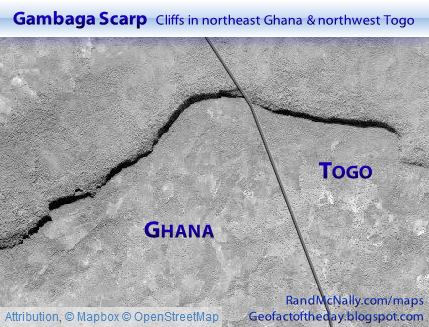
Gambaga Scarp is a physical landform feature located at the border of two regions in GHANA, a multilingual and English-speaking country in West Africa. A forested region of multiple cliffs along the Volta River basin, Gambaga Scarp horizontally stretches about 75 miles and 120 kilometers along the southern border of Upper East province and northeast border of Northern province. It also extends eastward to Tandjouaré prefecture (Savanes region) in northwestern TOGO.
The satellite image above — from randmcnally.com/maps and attributed to MapBox and OpenStreetMap — shows just a section of Gambaga Scarp near the border between Ghana and Togo. Crops such as yams and grain are grown and livestock are raised in the area with the help of a relatively cool microclimate. The region of cliffs is generally located over 1,000 feet and 300 meters in elevation. Various cities and small towns dot the area surrounding Gambaga Scarp. They include Bolgatanga, Gambaga, Nakpanduri, Nalerigu, Namasu, and Zarantinga in Ghana and Doré and Nano in Togo.
Tuesday, May 14, 2013
Administrative Divisions of Togo
 The skinny country of TOGO, located in Western Africa and west of Benin, south of Burkina Faso, and east of Ghana, is divided up into five regions (also spelled with an acute accent/accent aigu: régions) and prefectures (also spelled préfectures). The five régions from north to south are Savanes, Kara, Centrale, Plateaux, and Maritime. Below is a list showing what préfectures are in each region.
● Savanes: Oti and Tône
● Kara: Assoli, Bassar, Bimah, Doufelgou, Kéran, and Kozah
● Centrale: Sotouboua, Tchamba, and Tchaudjo
● Plateaux: Amou, Haho, Kloto, Ogou, and Wawa
● Maritime: Golfe, Lacs, Vo, Yoto, and Zio (Lomé, Togo's capital, is also a préfecture)
The map I made shows the préfectures of Togo. Shapefiles used to make this map came from the website Global Administrative Areas.
Monday, May 13, 2013
Location and Regions of Togo
A skinny country in West Africa west of Benin, south of Burkina Faso, and east of Ghana, TOGO has a coastline with the Atlantic Ocean on its southern border. The country is divided up administratively into five régions, which are then divided up into smaller préfectures. The five régions are, from north to south, Savanes, Kara, Centrale, Plateaux, and Maritime.
Wednesday, March 20, 2013
Africa's Thin Countries
If you looked at a map of Africa, you may or may not have noticed that there are several small, very thin countries. While countries such as Lesotho and Sierra Leone are rather round, Africa is home to five extremely skinny countries. The West Africa region boasts the most with three: they are BENIN, GAMBIA*, and TOGO. East Africa has one country that is diagonally skinny: ERITREA, bordering the Red Sea and located north of Ethiopia. Located in Southern Africa, MALAWI is the remaining skinny country. It straddles the vertically oriented Lake Malawi and the Great Rift Valley.
* Gambia's north and south borders are on both sides of the horizontally flowing Gambia River
Monday, May 3, 2010
Togo

 TOGO is a thin, French-speaking country located in West Africa. There are 3 bordering countries: Benin to the east, Burkina Faso to the north, and Ghana to the west. Togo also borders the Gulf of Guinea and the Atlantic Ocean along its southern coastline. The capital and most-populated city is Lomé. Other cities include Bassar, Guérin-Kouka, Kpèssi, Mango, Sokodé, Tabligbo, Tchamba, and Yégué. The currency is the West African Franc, and its ISO 4217 currency code is XOF.
Subscribe to:
Posts (Atom)
Thanks for Visiting from Anywhere in the World!