
Informative geography facts about our wonderful planet, detailed and easy-to-read maps, and various topics about each country! I am pleased to update my blog as a passion project and do not generate content with AI.
Showing posts with label Uganda. Show all posts
Showing posts with label Uganda. Show all posts
Thursday, February 23, 2023
February 2023 Language Quiz
Questions for this quick geography quiz are inspired by the Language of the Day series from Ethnologue (ethnologue.com). You can further test your geographic knowledge (↗) with more quizzes from GeoFact of the Day. The answers to this quiz are listed below; enjoy and good luck!
1) Which option is the Southeast Asian country where Pwo Western Karen is a threatened language with about 210,000 (and possibly decreasing) speakers?
A — MYANMAR
B — MADAGASCAR
C — UGANDA
D — TURKEY
2) With only about 280 speakers, the Hiw language is used for communication in which country in Oceania?
A — SAMOA
B — VANUATU
C — TONGA
3) Which of the following languages is not used for communication in PAPUA NEW GUINEA?
A — Opao
B — Vincentian English Creole
C — Saruga
D — Siroi
4) Which option below is the East African country in which over 3.4 million people communicate with the Nyankore (Nkore) language?
A — UGANDA
B — TOGO
C — AZERBAIJAN
D — KAZAKHSTAN
ANSWERS
Question 1:
A . . . . . Myanmar
Question 2:
B . . . . . Vanuatu
Question 3:
B . . . . . Vincentian English Creole
Question 4:
A . . . . . Uganda
Thursday, January 26, 2023
January 2023 Africa Trivia Quiz
Happy New Year! January 2023’s continental quiz is a continuation of the Africa GeoQuiz in December of last year. After testing your African trivia prowess, you can further test your geographic knowledge (↗) with other geography quizzes from GeoFact of the Day. The answers are listed below; enjoy and good luck!
1) Fill in the blank: _________ from desert land in present-day MALI was once so highly prized that an ounce of this resource carried the same value as an ounce of gold!
A — sand
B — salt
C — pepper
2) True or false: the Olduvai Gorge, Serengeti grassland region, and Mount Kilimanjaro are all notable landscape features of northern UGANDA.
3) The naming (etymology) of BURKINA FASO translates in English to “land of the honest men” as well as “land of the _________.”
A — liars
B — incorruptible
C — brazen
4) Fill in the blank: tucked in the northeast corner of EQUATORIAL GUINEA, Ebebiyín is a “corner city” of about 36,000 residents near _________ as well as GABON.
A — CAMEROON
B — DJIBOUTI
C — LESOTHO
D — MADAGASCAR
5) MAURITIUS is one of the first countries around the globe to convert a relatively unconventional material to generate electricity. Steam turbines powered by this crop produce up to one fifth (1/5) of the island’s electricity during the annual harvest season! Which crop is especially used in Mauritius for energy needs?
A — broccoli
B — sugarcane
C — plantains
D — guava, mangoes, and papaya
6) True or false: Lake Togo gave the country of TOGO its name. Togo is derived from the Ewe word togodo, meaning “behind the lake.”
7) One provincial name in SOUTH AFRICA translates from the Sotho language into English as the “place of gold.” Which is the correct province?
A — Gauteng
B — Kwazulu-Natal
C — Western Cape
ANSWERS
Question 1:
B . . . . . salt
Question 2:
False . . . . . northern Tanzania
Question 3:
B . . . . . incorruptible
Question 4:
A . . . . . Cameroon
Question 5:
B . . . . . sugarcane
Question 6:
True
Question 7:
A . . . . . Gauteng
Friday, October 9, 2020
Independence Day in Uganda

People all across UGANDA are celebrating their country's Independence Day today. Uganda achieved independence from The United Kingdom in 1962. Happy Independence Day!
Wednesday, July 4, 2018
Uganda is Known for...
● Being nicknamed the Pearl of Africa
● Entrepreneurialism
● Idi Amin
● Lake Victoria and its tranquil scenery
● Mountains of the Moon – Rwenzori Mountains
● Murchison Falls
● Rare mountain gorillas
● White Nile River
Most items were listed in The Africa Book; the MLA citation is below. What are other "trademarks" of this African country? Feel free to share your thoughts with a comment!
Phillips et al. The Africa Book: A Journey through Every
Country in the Continent. Lonely Planet, 2007.
— #AfricaWeek —
Monday, January 8, 2018
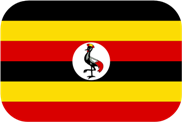
Uganda Exports
According to National Geographic MapMaker (mapmaker.nationalgeographic.org) and MIT's Observatory of Economic Complexity (atlas.media.mit.edu), the following items are major exports of UGANDA: aircraft parts, animal hides, baked goods, beverages, broadcasting equipment, buckwheat, cassava, cement, clothing and textiles, cobalt, cocoa beans, coffee, construction vehicles, copper, corn (maize), cotton (raw and prepared), cut flowers and other horticultural items, dried legumes, electricity to neighboring countries, flour, frozen vegetables, glass bottles, gold, iron products, leather, limestone, milk and concentrated milk, millet, oilseeds, potatoes, pulses, rice, seafood, soap, steel, sugar, tea, and tobacco. According to February 2017 statistics from the International Monetary Fund (data.imf.org), countries and territories buying and importing most of those exports include Kenya (top importer), South Sudan, Rwanda, Democratic Republic of the Congo, Italy, Tanzania, the Netherlands, Burundi, Sudan, Hong Kong, the United States, the United Arab Emirates, Belgium, Switzerland, Germany, China, Spain, India, Tunisia, Zambia, and Portugal.
Thursday, May 25, 2017
Uganda's Kasubi Tomb Ruins
Surrounded by the urban sprawl of west-side Kampala, UGANDA, the forested Kasubi Royal Tombs site experienced a mysterious fire on March 16th, 2010. Dedicated to the kings (kabakas) ruling over the Buganda Kingdom's Baganda people, the Kasubi Tombs were housed underground in a hilltop mausoleum since the 13th century. The latest mausoleum building was originally constructed in 1882 by Kabaka Mutesa I to be a palace and then was converted as a burial location two years later. This Muzibu Azaala Mpanga mausoleum was once the world's largest grass-thatched hut and was considered the site's main building. While the mausoleum was completely destroyed by flames, the cultural traditions and construction techniques of the Buganda Kingdom people persevered through time.

Utilizing information based on historic precedent, a replica building project was spearheaded in 2013 by UNESCO, a world-heritage organization which donated 2 billion Ugandan Shillings ($554,800 USD today) for the initiative. According to the Daily Monitor (Kampala) newspaper, however, the reconstruction process was recently halted. The "Tombs of Buganda Kings at Kasubi" was inscribed as a UNESCO World Heritage Site (↗) in 2001 and listed on the List of World Heritage in Danger (↗) in 2010. More information and photos pertaining to this site of destruction and rebirth — about the thatching technique, royal drums, mausoleum's floor plan, mausoleum's interior, etc. — can be found at the Kabaka Foundation's Kasubi Tombs website (↗).
Wednesday, November 30, 2016
Uganda Endangered Species

The IUCN Red List of Threatened Species™ for UGANDA in Central and Eastern Africa lists 1 extinct species (Xystichromis bayoni fish), 48 critically endangered species, and 39 endangered species. Some of Uganda's forty-eight critically endangered species are the Caridina subventralis shrimp, Du Toit's Torrent Frog*, Haplochromis michaeli cichlid fish, Haplochromis microdon cichlid fish, Haplochromis percoides cichlid fish, Hooded Vulture, Rueppell's Griffon, Singidia Tilapia fish, White-Backed Vulture, and White-Headed Vulture. Endangered species include the Albert Lates fish (named after Lake Albert, Barbour's Vlei Rat, Basra Reed Warbler, Common Chimpanzee, Egyptian Eagle, Golden-Naped Weaver bird, Grauer's Rush Warbler bird, Malagasy Pond Heron, Montane Mouse Shrew, Montane Shaggy Rat, Mountain Gorilla, Nahan's Partridge, Okapi mammal (basically a combination of features from the Giraffe and Zebra), Southern Crown Crane, and Ugandan Shrew. Species named after Uganda include the Uganda Clawed Frog, Uganda Duskhawker dragonfly, Uganda Five-Toed Skink, Uganda Nothobranch fish, Uganda Spotted Woodpecker, Uganda Woodland Warbler, Uganda Lowland Shrew, and Uganda Musk Shrew.
* This species was formerly listed as extinct in 1996, but the 2004 IUCN Red List declared that there is not enough evidence of this being true. Therefore, it is possibly extinct in their habitat — which is located on the slopes of Mount Elgon (Swahili: Mlima Elgon) of western Kenya and eastern Uganda.
Saturday, December 29, 2012
Uganda National Parks
Like several African countries, UGANDA reserves a portion of its grasslands, marshes, and rainforests for conservation. Located to the west and east of branches of the Great Rift Valley in East-Central Africa, Uganda maintains national parks in all four cardinal directions: north, east, west, and south. Located in northeast Uganda, Kidepo Valley NP is surrounded by peaks like Lwala (2,456 m), Rom (2,352 m), and Lotuke (2,797 m, over the border in South Sudan). Parks in eastern Uganda are game reserves: they include Bakora, Matheniko, and Pian-Upe. The Bwindi Impenetrable NP is in the southwest panhandle of Uganda, west of the city of Virunga; hence the 'impenetrable' part of the name, it is not very accessible (only for walking, and that is difficult). Located in southern Uganda amongst marshes and swamps - west of Lake Victoria - is Lake Mburo NP. Lastly, western Uganda national parks include Kabalega NP and Ruwenzori NP. Most, if not all, of these national parks are crucial for protecting endangered species, like mountain gorillas, as they preserve their habitat and inhibit the act of poaching.
Sunday, December 5, 2010
Lake Victoria
 Lake Victoria, Africa's largest lake, shares borders with Kenya, Tanzania, and Uganda. Not only that, but Lake Victoria is the largest tropical lake in the world and the largest lake near the Equator, between the Tropic of Capricorn and the Tropic of Cancer. It is the second largest freshwater lake in the world (Lake Superior is the only larger freshwater lake). Also neat about Lake Victoria is the fact that there are around 3000 islands in it! This lake is named after Queen Victoria.
Wednesday, May 5, 2010
Uganda

 UGANDA is a landlocked country located in Eastern Africa. Democratic Republic of the Congo, Kenya, Rwanda, and South Sudan are bordering countries. Uganda also borders Lake Victoria, Africa's largest lake. There are other large lakes in Uganda, including Lake Albert and Lake Edward. The capital and most-populated city is Kampala. Other cities include Arua, Gulu, Kabale, Kisoro, Lira, Mbarara, Soroti, and Tororo. The currency is the Ugandan Shilling, and its ISO 4217 currency code is UGX.
Tuesday, October 13, 2009
Nile River

The Nile River is sometimes known as the longest river in the world — contending with the Amazon River for the longest river designation. The Nile River stretches for more than 4,100 miles and almost 6,600 miles long! The Nile and its major tributaries — the Blue Nile (east) and White Nile (south) — runs through 11 countries in Africa: Burundi, Democratic Republic of the Congo, Egypt, Eritrea, Ethiopia, Kenya, Rwanda, South Sudan, Sudan, Tanzania, and Uganda. The northern and main portion of the Nile is found in Egypt and Sudan. The Blue Nile predominantly flows through Ethiopia and Sudan. The White Nile is especially wide in South Sudan, Sudan, and Uganda.
0
- Post Comment Here
 Tags »
Burundi,
Congo (DR),
Egypt,
Eritrea,
Ethiopia,
GeoFact of the Day,
Kenya,
Maps,
Rwanda,
South Sudan,
Sudan,
Tanzania,
Uganda,
Water
Tags »
Burundi,
Congo (DR),
Egypt,
Eritrea,
Ethiopia,
GeoFact of the Day,
Kenya,
Maps,
Rwanda,
South Sudan,
Sudan,
Tanzania,
Uganda,
Water
Tags »
Burundi,
Congo (DR),
Egypt,
Eritrea,
Ethiopia,
GeoFact of the Day,
Kenya,
Maps,
Rwanda,
South Sudan,
Sudan,
Tanzania,
Uganda,
Water
Subscribe to:
Posts (Atom)
Thanks for Visiting from Anywhere in the World!