Search for Posts, Maps, and Topics
There is a county in Missouri named for a river and a particular group of people in FRANCE who were stereotypically known for being boastful and boisterous. This county’s name is a lowercased word in the Merriam-Webster dictionary. Which county is it? Choose an option and find the answer further below!
A — Audrain County
B — Gasconade County
C — Chariton County
D — Buchanan County
Answer:
B — Gasconade County
Happy Mother's Day on Sunday!
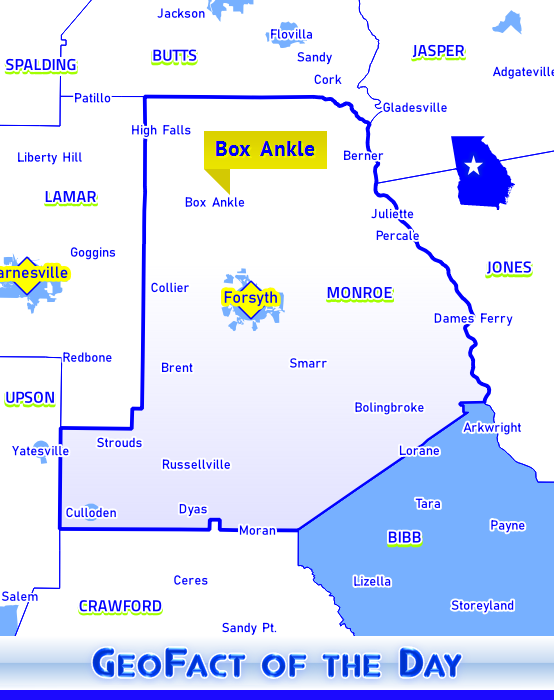
Box Ankle is an interestingly named community in Monroe County in the state of Georgia! Plenty of details on the naming of Box Ankle are provided by Georgia Public Broadcasting (↗). Surrounding communities include Collier, Forsyth (county seat of Monroe County), Goggins, and High Falls.
While the hot season of summer is winding down, a town in Metcalfe County in the state of Kentucky has a name evoking the relief of finding shelter from the blistering sun. A census-designated place with the name of Summer Shade seems to have summer all year long — but in name only! The all-seasons community of Summer Shade is nestled near the southwestern corner of Metcalfe County near Barren and Monroe counties. Surrounding communities include Cedar Flats, Curtis, Cyclone, Dubre, Edmonton (county seat of Metcalfe County), Goodluck, Kino, Randolph, and of course Willow Shade.
Bordering the Lac qui Parle Lake and Minnesota River, I am a county in southwestern Minnesota and was established in the year 1870, making me over 150 years old! I am so tantalizingly close to South Dakota; I'm only about 20 miles (32.2 kilometers) away. State Roads 7, 23, 29, 40, and 277 as well as U.S. Routes 49 and 212 are major highways, and I'm named after a Native American tribal group. My neighbors are Kandiyohi, Lac qui Parle, Renville, Swift (not Taylor Swift, though...I wish!), and Yellow Medicine counties. With approximately 5,000 residents, the town of Montevideo serves as my county seat and shares the same name as URUGUAY's national capital. What in the World is my name? Choose an option and find out below!
A — Sioux County
B — Chippewa County
C — Oglala Lakota County
Answer: B — my name is Chippewa County
Happy Mother's Day!
 As you can see by the "sea of blue" stretching across the map above, a vast majority of counties (68) in Indiana, USA are named after honorable people who were either born as an American or British citizen. Adams, Harrison, Jackson, Jefferson, Madison, Monroe, and Washington counties are named in honor of U.S. Presidents. Four counties are named in honor of Native American groups/nations or individuals: Delaware (Delaware nation), Elkhart County (possibly Chief Elkhart), Miami County (Miami nation), and Wells County (William Wells, raised by Miami natives).
Three counties are named for war heroes who were born within the geographic territory (Holy Roman Empire, Prussia, etc.) that is now considered present-day GERMANY: DeKalb County (Johann de Kalb, a baron), Jasper County (William Jasper), and Steuben County (Baron von Steuben). Sergeant William Jasper's birthplace is disputed, but South Carolina Educational Television's Knowitall.org website (↗) theorizes that he likely emigrated from Germany to Philadelphia in 1767 (at about age 17) and later moved to the South, eventually rescuing the South Carolinian flag at Fort Moultrie. The United States Mint's 2016 America the Beautiful quarter for South Carolina (↗) depicts an active and heroic scene at Fort Moultrie; on this coin, Jasper is "returning the regimental flag to the ramparts while under attack from a British ship."
Tadeusz Kosciuszko (Kosciusko) and Kazimierz Pulaski were born in present-day POLAND. Toussaint Dubois was born near present-day Montreal, CANADA, Gilbert du Motier (Marquis de la Fayette) was born in FRANCE, Richard Montgomery was born in the Kingdom of IRELAND, and Francis Vigo was born in present-day ITALY. Only 11 counties are not named after war heroes, patriots, leaders, Native American groups, or Native American individuals: LaGrange, Lake, LaPorte, Ohio, Orange, Saint Joseph, Switzerland, Tippecanoe, Union, Vermillion, and Wabash counties.
Bonus Fact: Alexander Hamilton — who is honored in the name of Hamilton County in Indiana and seven other states — was born in the city of Charleston, British Leeward Islands. Charleston sits on Nevis island which is presently part of the country SAINT KITTS AND NEVIS.
The State of Alabama in the UNITED STATES maintains a constellation of public lakes throughout its territory. The map below shows how public county lakes are present in 21 counties located in various geographic regions. There are indeed public lakes in some other Alabamian counties that are not blue-shaded, but this map indicates the 21 counties that have at least one lake with "public county lake" or "county lake" in its name.

In alphabetical order, the 21 blue-shaded counties are Barbour, Bibb, Chambers, Clay, Coffee, Conecuh, Crenshaw, Dale, Dallas, DeKalb, Escambia, Fayette, Geneva, Lamar, Lee, Madison, Marion, Monroe, Pike, Walker, and Washington. Marengo County used to be part of the state’s county-lake system, but the 40-acre public lake is now “privately owned” according to the Marengo Lake Web Page (↗). Fish icons for county public lakes — except for Concecuh County — are displayed in the 2017-2018 Alabama Official Transportation Map.
 More than a couple dozen villages and towns in Arkansas (UNITED STATES) share the same names with countries and capital cities around the world. While not known as countries in the fully sovereign sense, England and Scotland are commonly known as countries nestled within the greater United Kingdom. Also, non-sovereign Palestine is recognized by 137 countries to be an official state as of December 2018. The table below lists every Arkansas town named after a country or capital city, followed by the county it is situated in. If a place is an incorporated community, the population count of that place is written in the third column. Logan, Mississippi, and Union counties each have two towns named after capital cities. Conway, Faulkner, Jefferson, and Van Buren counties each have one town named after a country and another town named after a capital city.
Capital Cities
Athens
Berlin
Damascus
Dublin
Havana
Jerusalem
Lisbon
London
(New) London
Manila
Moscow
Paris
Victoria*
| Howard County
Ashley County
Faulkner and Van Buren counties
Logan County
Yell County
Conway County
Union County
Pope County
Union County
Mississippi County
Jefferson County
Logan County
Mississippi County
|
382
375
1,039
3,342
3,532
37
|
Close spelling: Tokio (Hempstead County)
* Victoria is the capital of the Seychelles islands, east of continental Africa.
Countries
Congo
Denmark
Egypt
England
Holland
(Little) Italy
Jordan
Macedonia
Palestine
Saint Vincent*
Scotland
Slovak^
Sweden
| Saline County
Jackson and White counties
Craighead County
Lonoke County
Faulkner County
Perry and Pulaski counties
Baxter County
Columbia County
Saint Francis County
Conway County
Van Buren County
Prairie County
Jefferson County
|
112
2,825
557
681
|
Close spelling: Soudan (Lee County)
* Saint Vincent and the Grenadines — ^ Slovak Republic (Slovakia)
Did I leave one out? Your suggestion as a comment below would be greatly appreciated!
 Basilicata, a region in the southern "sole" of ITALY's boot. As pinpointed on the DuckDuckGo map below, Basilicata's capital city is Potenza (pop. 68,000). Base-map layer and data © Mapbox and OpenStreetMap.

 Click on the map image above to enlarge it in a pop-up lightbox window.
With about 200 kilometers of seawater separating it from Cuba and Haiti, JAMAICA is an emerald-green island country in the northwest Caribbean Sea. Regarding administrative divisions of its land, Jamaica is comprised of fourteen (14) parishes: Clarendon, Hanover, Kingston, Manchester, Portland, Saint Andrew, Saint Ann, Saint Catherine, Saint Elizabeth, Saint James, Saint Mary, Saint Thomas, Trelawny, and Westmoreland. Below are the parishes' first-order administrative capital cities:
Clarendon — May Pen
Hanover — Lucea
Kingston — Kingston (national capital)
Manchester — Mandeville
Portland — Port Antonio
Saint Andrew — Half-Way-Tree
Saint Ann — Saint Ann's Bay
Saint Catherine — Spanish Town
Saint Elizabeth — Black River
Saint James — Montego Bay
Saint Mary — Port Maria
Saint Thomas — Morant Bay
Trelawny — Falmouth
Westmoreland — Savanna-la-Mar
 Images are automatically updated by the U.S. Drought Monitor.
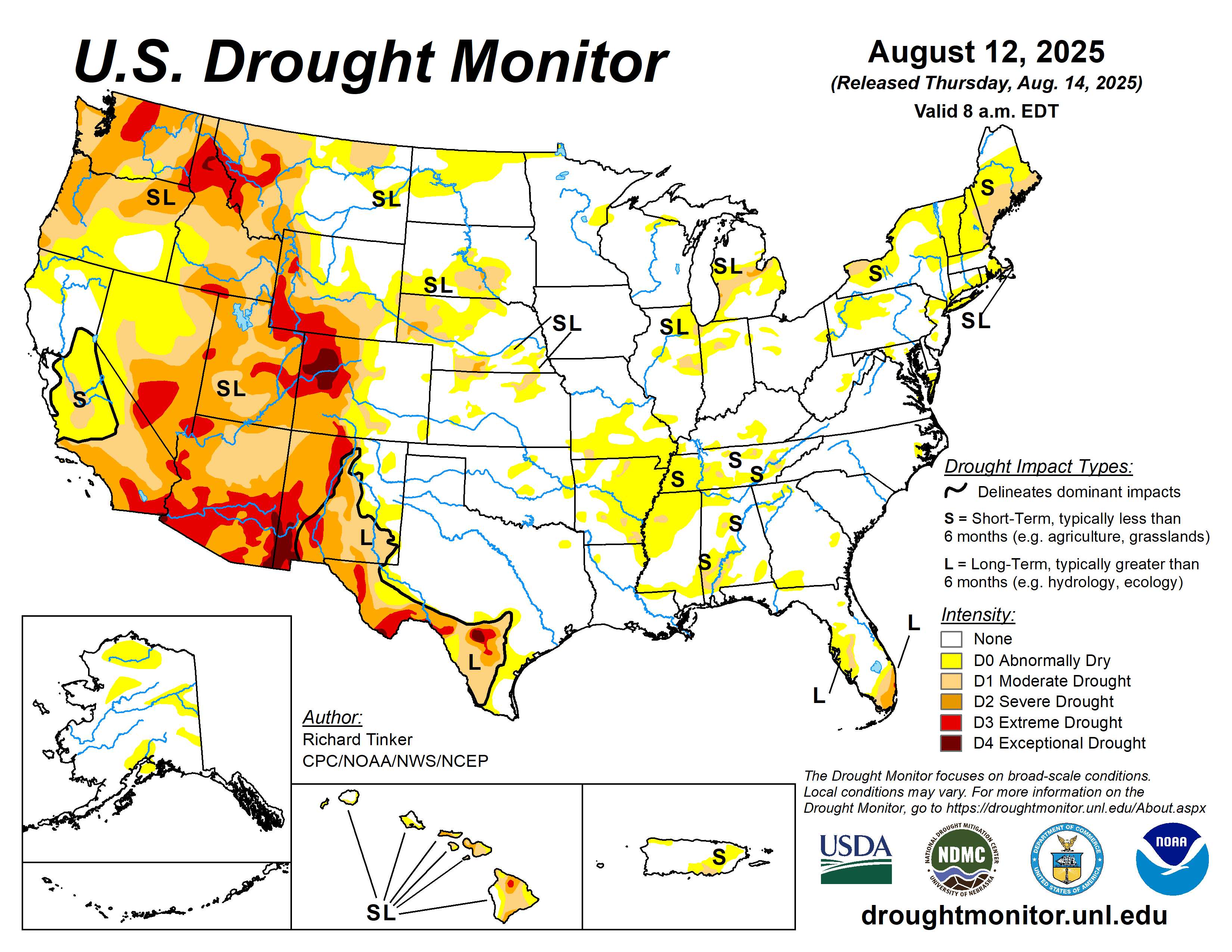
As of Thursday, July 13th, a geographic area of Extreme Drought covers a northern portion of the continental UNITED STATES OF AMERICA. The U.S. Drought Monitor (↗) notes that this should be a short-term drought, typically lasting less than six months. The areas affected are northeastern Montana; central, southern, and southwest North Dakota; and northern South Dakota. More specifically, the following counties are currently experiencing this Severe Drought:
● ● ● ● ● Montana — Blaine, Custer, Daniels, Dawson, Fergus, Garfield, McCone, Petroleum, Phillips, Prairie, Richland, Roosevelt, Rosebud, Sheridan, Valley, and Wibaux
● ● ● ● ● North Dakota — Adams, Billings, Bowman, Burleigh, Divide, Dunn, Emmons, Golden Valley, Grant, Hettinger, Kidder, Logan, McHenry, McIntosh, McKenzie, McKinley, McLean, Mercer, Morton, Mountrail, Oliver, Sheridan, Sioux, Slope, Stark, Ward, and Williams
● ● ● ● ● South Dakota — Campbell, Corson, Dewey, Edmunds, Faulk, Hyde, McPherson, Perkins, Potter, and Sully

* Thanks to heavy rain starting off the 2017 year, about 62% of California is free from drought and abnormal dryness, compared to only 0.43% a year ago. While almost 38.5% of California experienced a long-term Exceptional drought on Feb. 23rd, 2016, there are now no regions in the Golden State with this severe drought level. Areas west of Santa Barbara and near Yuma, Arizona currently have a Severe drought, which is a level below Extreme.
Recent severe drought conditions in multiple Southern states in the UNITED STATES OF AMERICA — ranging from Kentucky southward towards Florida — have unfortunately helped to create harmful and lethal wildfires. Originating on Chimney Tops mountain in the Great Smoky Mountains National Park because of arson, the Chimney Tops 2 wildfire in Sevier County, Tennessee unfortunately killed fourteen people and caused evacuations and damage in two popular resort towns: Gatlinburg and Pigeon Forge. According to the National Inter-Agency Fire Center, one large wildfire in Georgia and two large wildfires in Tennessee are still being contained by courageous firefighters. The total acreage of these current fires is approximately 42,500 acres. There are some good news: recent precipitation and storms helped shrink the area of severe, extreme, and exceptional droughts as well as extinguish some of the burning areas.
The first map below shows drought conditions in the Southeastern U.S. as of December 7th, 2016. Subsequent maps show the following interstate regions: (1) northern Alabama and northeastern Mississippi, (2) a small exceptional drought region in southeastern Alabama (and extreme western part of Stewart County, Georgia), (3) central and northern Georgia and four counties in western South Carolina, and (4) western North Carolina and southeastern Tennessee. The United States Drought Monitor's newest map was released a day later and reveals a slightly less-severe drought situation than GeoFact of the Day Blog maps show. For example, Southeastern Tennessee used to have an Exceptional Drought (highest level) encompassing almost 14% of the state. This drought recently came down one severity level to become an Extreme Drought. Additionally, the Monitor's Tennessee page reveals that the geographic Extreme-to-Exceptional drought area shrank from 60.43% statewide to 12.28% statewide. Did You Know? An overwhelming amount of wildfires are caused by people. More than 90% of wildfires in the United States are caused by human accidents and purposeful (despicable) arson, according to the National Weather Service! Legend and drought maps below:


 Click on the map image above to enlarge it in a pop-up window.
Sharing the western half of Hispaniola island with Dominican Republic to the east, the HAITI is administratively divided into 10 Departments (French: Départements) as well as over 40 Arrondissements. In alphabetical order, Haiti's provinces are L'Artibonite, Centre, Grand'Anse, Nippes, Nord, Nord-Est, Nord-Ouest, Ouest (location of Port-au-Prince, Haiti's capital), Sud, and Sud-Est. Established in 2003 from Grand'Anse department, Nippes is technically translated from French into English as clothing — or duds! On the GeoFact of the Day Blog map above, the country's major islands are labeled near green text. Haiti has an affinity for its wildlife and livestock, enough to name a couple islands after beloved creatures. Haiti's southernmost island is essentially named Cow (Vache), while the northernmost one is named Turtle (Tortue, or Tortuga).
 Click on the map image above to enlarge it in a pop-up window.
Sharing the eastern half of Hispaniola island with Haiti to the west, the DOMINICAN REPUBLIC is administratively divided into 31 Provinces (Spanish: Províncias) and a National District (Distrito Nacional*). In alphabetical order, the Dominican Republic's provinces are Azua, Bahoruco (also known as Baoruco), Barahona, Dajabón, Duarte, El Seybo (also known as El Seibo), Elías Piña (also known as La Estrelleta), Espaillat, Hato Mayor, Hermanas Mirabal (formerly known as Salcedo), Independencia, La Altagracia, La Romana, La Vega, María Trinidad Sánchez, Monseñor Nouel, Monte Cristi, Monte Plata, Pedernales, Peravia, Puerto Plata, Samaná, San Cristóbal, San José de Ocoa, San Juan, San Pedro de Macorís, Sánchez Ramírez, Santiago, Santiago Rodríguez, Santo Domingo, and Valverde. Since November 2007, the province of Salcedo (named after Francisco Antonio Salcedo, an 1800s war hero) became renamed to Hermanas Mirabal — in honor of four sisters (Dedé, María Teresa, Minerva, and Patria) who led an inspirational opposition movement against dictator Rafael Trujillo. The capital and most-populated city of Hermanas Mirabal Province is still named Salcedo.
* This is where Santo Domingo, the Dominican Republic's capital, is located.
 Click on the map image above to enlarge it in a pop-up window.
Known as the largest island country in the Caribbean Sea, CUBA has a total of 16 provinces — provincias in Spanish. In alphabetical order, they are Artemisa, Camagüey, Ciego de Ávila, Cienfuegos, Granma, Guantánamo, Holguín, Isla de la Juventud, La Habana (Havana, Cuba's capital), Las Tunas, Matanzas, Mayabeque, Pinar del Río, Sancti Spíritus, Santiago de Cuba, and Villa Clara. Artemisa and Mayabeque Provinces came into existence in 2011, when both provinces were created from the former La Habana Province. The current La Habana Province is now the country's smallest province.
 Click on the map image above to enlarge it in a pop-up lightbox window.
An island country boasting about 700 islands and even more coral reef cays, The BAHAMAS is administratively divided into 32 Districts. There is also a "non-district" called New Providence, where the national capital (Nassau) is located. As shown on the map above, the Bahamas' districts are Acklins, Berry Islands, Bimini, Black Point, Cat Island, Central Abaco, Central Andros, Central Eleuthera, City of Freeport, Crooked Island, East Grand Bahama, Exuma, Grand Cay, Green Turtle Cay, Harbour Island, Hope Town, Inagua, Long Island, Mangrove Cay, Mayaguana, Moore's Island, North Abaco, North Andros, North Eleuthera, Ragged Island, Rum Cay, San Salvador, South Abaco, South Andros, South Eleuthera, Spanish Wells, and West Grand Bahama.
 Click on the map image above to enlarge it in a pop-up lightbox window.
Located south of Grenada and close to northeastern Venezuela, TRINIDAD and TOBAGO is administratively divided up into ten Regions or Regional Corporations, three City Corporations, and five Boroughs. Trinidad and Tobago's ten regions are Couva-Tabaquite-Talparo (Couva), Diego Martin (Petit Valley), Mayaro-Rio Claro, Penal-Debe (Penal), Princes Town, San Juan-Laventille (Laventille), Sangre Grande, Siparia, Tobago, and Tunapuna-Piarco (Tunapuna). Except for Tobago Region, regions are named after at least one town or city. The national capital — Port of Spain — and San Fernando are city corporations, and the three boroughs are Arima, Chaguanas, and Point Fortin. Until the 1990s, the country's former first-level administrative divisions were counties with multiple wards in each one. More information about this country can be found in my Trinidad and Tobago post (↗)!
 Click on the map image above to enlarge it in a pop-up lightbox window.
A country located north of Grenada and south of Saint Lucia in the Windward Islands group, SAINT VINCENT and the GRENADINES comprises over 30 islands and cays in the Caribbean Sea. Small islands in the south are part of the Grenadines archipelago — which stretches even further southward, giving Grenada possession of hundreds of islands. The St. Vincent and the Grenadines country is administratively divided up into six parishes: Charlotte, Grenadines, Saint Andrew, Saint David, Saint George, and Saint Patrick. Below are these parishes' first-order administrative capital cities:
Charlotte — Georgetown
Grenadines — Port Elizabeth
St. Andrew — Layou
St. David — Chateaubelair
St. George — Kingstown (national capital)
St. Patrick — Barrouallie
More information about this country can be found in my original Saint Vincent & the Grenadines post — which has been slightly updated.
 Click on the map image above to enlarge it in a pop-up lightbox window.
Part of the Windward Islands and located north of Saint Vincent and the Grenadines, SAINT LUCIA used to have Quarters as administrative divisions until 2014; these are now called Districts, according to Statoids. In alphabetical order, the 10 districts of Saint Lucia are Anse la Raye (Anse-la-Raye), Canaries, Castries, Choiseul, Dennery, Gros Islet, Laborie, Micoud, Soufrière, and Vieux Fort. Below are these parishes' capital cities, with the exact same names as their districts:
Anse la Raye — Anse la Raye
Canaries — Canaries
Castries — Castries (national capital of St. Lucia)
Choiseul — Choiseul
Dennery — Dennery
Gros Islet — Gros Islet
Laborie — Laborie
Micoud — Micoud
Soufrière — Soufrière
Vieux Fort — Vieux Fort
Blog Content
● The author of this GeoFact of the Day Blog creates and curates original, authentic content and posts information based on established facts. Blog posts are not generated by artificial intelligence (AI) but published by the author.
● Content and image graphics from other sources are properly credited. Many geography facts are well-established and therefore do not belong to any one source, but occasionally a fact requires attribution/credit if it is unique and hard-to-find — for example, facts found from specific cultural, anthropological, geological, and scientific (etc.) research.
● I do not copy and paste from other websites. Therefore, all posts are original but may sometimes include information, links, and/or images from credited external sources. To use a GeoFact of the Day Blog image for your website or project, write a comment below a post — then I may approve your request.
● Feel free to offer comments, suggestions, and compliments on any post or page! You can be anonymous. Spam comments with non-relevant links will be deleted.
● Thanks for your loyal readership on the educational and reliable GeoFact of the Day Blog, in existence since 2008!