Search for Posts, Maps, and Topics
People all across POLAND are celebrating their country's Independence Day on Wednesday, November 11th. In the year 1918, Poland restored independence after being partitioned by Austria-Hungary, Prussia, and Russia for over 120 years. I hope everyone in Poland will have a happy Independence Day!
Spot the Spelling Error #4! One word within this post was misspelled on purpose; it could be a country or product. Can't find it? Click the "1 - Post Comment Here" link below (on a computer) or scroll to the bottom of this post (on a mobile device) for the answer.
According to National Geographic MapMaker (mapmaker.nationalgeographic.org) and other sources, the following items are major exports of POLAND: apples and pears, automobiles, baked goods, beverages, chemicals, chocolate, coal, coffee, combustion engines, computers, copper, dairy products, electric heaters, electric transformers, equipment and machinery, frozen fruit and nuts, furniture, gas turbines, insulated wire, iron, livestock, manufactured goods, meat, medical supplies, metal alloys, natural gas, orthopedic devices, packaged food, pharmaceuticals, plastic products, potatoes, rubber tires, safety glass, salt, ships, silver, sulfur, tea, telephones, transportation equipment, vehicle parts, video displays, wheat, and wood carpentry. According to the International Monetary Fund (data.imf.org), countries and territories buying and importing most of those exports (February 2017 statistics) include Germany (top importer), the United Kingdom, Czech Republic, France, Italy, the Netherlands, Sweden, Spain, Russia, Hungry, the United States, Slovakia, Ukraine, Belgium, Austria, Denmark, Romania, Turkey, Lithuania, and Norway.
 See if you can answer these quiz questions pertaining to POLAND without the help of literary resources and the Internet. Answers are provided at the end — I wish you good luck!
1) How many countries share a land border with Poland?
A — 2
B — 5
C — 7
2) Currently as of September 2017, which Polish city does not have UNESCO World Heritage Site status for its historic district?
A — Kraków
B — Lublin
C — Zamość
3) True or False: The village of Koniówka contains a wooden tower with a "sacred" bell, the sound of which is meant to ward off "cloud demon" weather spirits.
4) The forested, southernmost border of Poland straddles the Carpathian mountain range. What horizontally oriented country — of which the east to west length is longer than the north to south length — is found immediately to the south of Poland?
____________________
5) A national census revealed that Polish is the second-most spoken language in a European country. In which country is this the case?
A — ESTONIA
B — MALTA
C — UNITED KINGDOM
D — PORTUGAL
ANSWERS
Question 1:
C . . . . . 7 (seven): Belarus, Czech Republic, Germany, Lithuania, Russia (Kaliningrad exclave), Slovakia, and Ukraine
Question 2:
B . . . . . Lublin
Question 3:
A . . . . . True
Question 4:
Slovakia
Question 5:
C . . . . . United Kingdom
So, how did you do? Thanks for taking this quiz! The map image above is credited to National Geographic's Mapmaker Interactive (↗).
The IUCN Red List of Threatened Species™ for POLAND in Eastern Europe lists 1 extinct species (Aurochs cattle), 1 extinct-in-the-wild species (Betula szaferi tree), 6 critically endangered species, and 17 endangered species. Poland's critically endangered species are the Balearic Shearwater, European Eel, European Mink, Saiga, Slender-Billed Curlew, and Sociable Plover. Endangered species include the Anthoceros neesii hornwort plant, Bythinella zyvionteki freshwater snail, Common Aldrovanda waterwheel plant, Egyptian Eagle, Freshwater Pearl Mussel, Huchen fish, Polish Scurvy Grass, Saker Falcon, Steppe Eagle, Thick-Shelled River Mussel, White-headed Duck, and Yellow-Breasted Bunting. Bythinella zyvionteki snails live in two known locations less than 10 kilometers (~6.2 miles) apart in the Kraków-Częstochowa Upland of south-central Poland.
GeoFact of the Day Exclusive Document
Citing this Work (MLA Formatting)
"Black Madonna of Czestochowa: One of the World’s Artistic Gems." GeoFact of the Day Blog. Wonderful World Blog Publishing, 2 July 2016. Web. http://geofactoftheday.blogspot.com/2016/07/black-madonna.html
Housed in the stately Jasna Gora (“Bright Mountain”) Monastery of Czestochowa (southern Poland), a bold gold frame above the altar borders a dark, dim, fifteenth-century painting: the Black Madonna (Our Lady) of Czestochowa (1434). It is an oil painting on wood and features a stunning accessory: an interchangeable “robe” frame covering encrusted with jewels. Attracting hundreds of thousands of Christian pilgrims annually for over six centuries (Karafilly 1998, H1), Poland’s famous Black Madonna has been replicated several times. One copy is found at the National Shrine of Our Lady of Czestochowa in Doylestown, Pennsylvania, another is found in Switzerland’s Hospice of the Great St. Bernard Pass (Duricy 2013), and others are found in various churches of England. Art historians and analysts have debated the significance and purpose of Black Madonna portraits. While Black Madonna portraits at Jasna Gora and other places worldwide might embody the resilient and generous spirit of Virgin Mary, these images have a wide variety of other meanings and symbolism as well.
Subject Matter and History
The Black Madonna of Czestochowa features Virgin Mary (Madonna) and her miraculous son, Jesus Christ. Her right hand gestures towards Jesus, and Jesus’ left index finger points upward towards his mother. Like with many examples of Roman Catholic artwork, the subjects’ heads are surrounded by golden haloes – to presumably denote their important status within Christianity. Meanwhile, the bejeweled frame covering includes crowns atop the heads of Madonna and Jesus. Jesus is holding an ornately designed, thick book – this may or may not be the Bible. Just like the Bible, the history of this artwork is not exactly well-documented or properly dated in time. This artwork was legendarily created or inspired by St. Luke the Evangelist (DICI 2012; Duricy 2013; Karafilly H1), while it may really be painted in the fifteenth century. St. Helena – Constantine’s Queen Mother – allegedly found the portrait when she visited the Holy Land (fourth century), and then she brought it to the city of Constantinople. It could have eventually arrived in Poland, when St. Ladislaus obtained this masterpiece in the 1400s (Duricy 2013). Four famous examples of these bejeweled picture frame (“robe”) coverings existed over the years, being named after the dominant material adorning the surface: diamonds, rubies, pearls, and chain. The current robe overwhelmingly sparkles with diamonds (Rozanow 2010). There are at least seven total robes, and only two are on public display (Karafilly H2).
After the 1400s, additional restorations took place. Art historian Ernst Scheyer conjectures that this painting was at least restored “in the nineteenth century and painted somewhat darker than previously.” The possible reasons why there is a “Black” Madonna – rather than white, as seen in many Western depictions of Madonna – are discussed in detail later below. Not everyone is pleased to venerate this Madonna image. In December 2012, she was vandalized with black paint (DICI 2012). This relatively recent case of vandalism is certainly not the first one; in 1430, Bohemian bandits stomped on and slashed the Madonna portrait; they also stole pilgrim’s votive gifts (Karafilly H1; Barham 2003, 330). A legend purports that these mischievous vandals ran away in horror when blood oozed out of the painting! Regardless of various cases of vandalism on her, the Black Madonna is said to have given miracles to the Polish people, who overcame invasive, dangerous groups such as the Swedes, Bolsheviks, and Nazis (Karafilly H1-2). Therefore, this gives hope to devout pilgrims that Madonna’s resiliency can help them overcome difficult times.
Style, Meanings, Symbolism, and Cultural Context
Anyone including art connoisseurs and first-time Jasna Gora visitors may instantly notice Madonna and Jesus wearing solemn and/or stoic facial expressions. This could signify that Christian worshippers should humbly and seriously respect them – as Jesus’ salvation of humans from sin is an important and serious task. Madonna also has two noticeable long scars and one shorter scar on her face. These scars – left alone by restorers to reveal the Bohemian vandals’ inexcusable action (Karafilly H1) – can represent the painful sorrows of her son’s crucifixion, and/or the adversity she might have faced in raising a son who constantly challenged authorities in power. She seems to hold Jesus on her arm and on the left part of her chest. However, the not-quite-perfect shadowing of Jesus and the ripples in Madonna’s clothing results in him levitating against her body – rather than being visibly anchored to her.
Compared to some subdued Christian paintings, colors are relatively vibrant. Madonna’s and Jesus’ bright, light-gold haloes are interconnected to each other – essentially signifying the unconditional love and interconnectedness of their mother-son relationship. I and some other art analysts would argue that Madonna’s purple robe symbolizes royalty and dignity, while her hood could signify that she is protective, humble, and respectable. Jesus’ red robe could represent the blood he unfortunately shed when being crucified and dying for humans’ sins. The artwork’s lighting is peculiar in that Madonna has a bright spot on her nose while Jesus does not. Also, there may be two relatively dim light sources coming from opposite directions. From our view, the left side of Madonna’s face is lit, while the opposite is true in regards to Jesus.
Visual-aid artwork in chapels, churches, synagogues, etc. helped illiterate worshippers understand main messages and tenets of the religion worshipped within these places. The diamond “robe” frame cover visually implies to Christians – even illiterate ones – that the subjects surrounded by jewels in this painting are meant to be revered for their immense importance in Christianity. A major component of Ancient to Medieval Art History is determining the styles and mannerisms of ancient societies’ artwork. According to Leonard Moss and other art historians and iconographers, the Madonna figure is “distinctly thirteenth-fourteenth century Byzantine in form” (Duricy 2013). Black Madonna of Czestochowa is a variety of Hodegetria iconography, in which Madonna is affirming – with her right hand – that her young boy is someone to respect and repent sins to. In an image caption contest, Madonna could be saying, “Look, everyone, my son right here is very important to Christianity.” Jesus might respond, “Yeah, but mom, you did the important task of giving birth to me and encouraging me to spread my message of salvation and love around the world!”
Theories of Why Madonna is Black
The skin of Madonna and Jesus in this painting is darker in color than their skin in many Western Christian artworks. Plenty of art historians, scholars, and iconographers have contributed their theories in regards to this. Joan Carroll Cruz suggests a possible link to the Song of Songs: “I am black but beautiful” (Duricy 2013). However, she also notes that accumulated residue from candles may have darkened the figures’ skin color. Similarly, Charles Broschart suggests that flames and smoke from a shrine fire darkened this image. If the Black Madonna was indeed Byzantine in style, maybe their skin color is similar to that of Byzantine people’s skin color (ibid.). Barham, Stephen Benko, and Gustafson all propose that black Madonnas resemble Earth and fertility goddesses, such as Artemis, Ceres (Demeter), Hecate, Kali, Isis, Medusa, and Rhea (Barham 326, 328; Duricy 2013; Gustafson 2009, 15). She might also represent the darkness of rich, fertile soil or serve to be “an icon of the mystery of life and death that defies definition and speaks to the deepest layers of the human soul” (Gustafson 18).
Conclusion
Throughout Europe, there is hardly a more populated pilgrimage site boasting a “mass of avid, hopeful humanity” (Karafilly H2) than the Jasna Gora monastery, featuring an artistic gem at the altar. Everyone is pointing fingers at each other: Jesus points up to his mother, Madonna hand gestures toward her son, and pilgrims arriving at Jasna Gora are fingering towards Jesus and the Virgin Mary in starstruck awe. With a rather gloomy yet brave facial expression, the Black Madonna hints at and displays her generosity, resiliency, and humility. While these characteristics are some that Christians easily attach to Virgin Mary, she represents a variety of other meanings, too – many of which orbit outside the Christian and religious realm.
Supplementing the debate of what Christian figures such as Jesus Christ and the Virgin Mary looked like as humans thousands of years ago, there is plenty of debate as to why the Virgin Mary featured in the Czestochowa image has a relatively dark skin tone. Some theories are grounded in practicality: Madonna may resemble the physical appearance of Byzantine people (who lived in what is now the Middle East, Turkey, etc.), or maybe candle soot somehow contributed to the painting’s overall darkness. Other theories address spirituality: the Black Madonna is an Earth goddess, and/or she embodies the vitality that fertile soil gives to plants and consequently other life forms on Earth. Her importance is exemplified by the scintillatingly glamorous robe covering that she and a young Jesus may occasionally wear at Josna Gory monastery. Regardless of what the Black Madonna truly represents, Christian pilgrims come far and wide to pay their respects to the Virgin Mary in southern Poland.
Works Cited
Barham, Penny. “Black Madonnas.” Feminist Theology: The Journal of the Britain & Ireland School of Feminist Theology 11.3 (2003): 325. Academic Search Premier. Web.
Duricy, Michael P. “Black Madonnas — Our Lady of Czestochowa.” Black Madonnas. International Marian Research Institute, University of Dayton, 5 Feb. 2013. http://campus.udayton.edu/mary/meditations/olczest.html.
Gustafson, Fred. The Black Madonna of Einsiedeln. Einsiedeln: Daimon Verlag, 2009. Print.
Karafilly, Irena F. “Poland's National Icon: In times of trouble, Poles have often turned for help to the Black Madonna of Czestochowa - and today their faith and fervor are undiminished.” The Montreal Gazette: pgs. H 1-4. 1998.
“Poland: The Black Madonna of Czestochowa Vandalized.” Documentation Information Catholiques Internationales, 21 Dec. 2012. Web. http://www.dici.org/en/news/poland-the-black-madonna-of-czestochowa-vandalized/.
Rozanow, Zofia. "New Robes of Our Lady of Czestochowa." Sunday Catholic Weekly. Niedziela, 2010. Web. http://sunday.niedziela.pl/artykul.php?dz=polska&id_art=00164.
Post #1 of UNESCO Heritage Sites Week
There are currently almost 30 transnational UNESCO World Heritage Sites transcending the boundary between more than one country. The Bialowieza (Białowieża) Forest is one example, situated along the western border of BELARUS and east-northeastern border of POLAND. Established as a heritage site in 1979, the Białowieża Forest is essentially one of Europe's only circa-8,000 BC forests remaining. Coniferous evergreens and deciduous trees commingle to provide habitat, shelter, and shade for various species including rare mammals and a bunch of birds. A lot more than the current population of about 300 European Bison used to live in this forest, but there was a period of time when there were no bison in the forest. Fortunately, the European Bison was reintroduced to Białowieża Forest shortly before 1930 and is now experiencing a general population increase. The bison is just one species saved by the Eastern European forest environment, and just one reason why this forest is featured as a World Heritage Site.
Several countries in Asia, Europe, and Oceania have the word land in their names. I nickname them the "Land Countries," which are listed right here: FINLAND, ICELAND, IRELAND, MARSHALL ISLANDS, The NETHERLANDS, NEW ZEALAND, POLAND, SOLOMON ISLANDS, SWAZILAND, SWITZERLAND, and THAILAND. Somaliland in northeast Africa is another entity with land in its name. However, it is an autonomous region in SOMALIA fighting for its independence, not a recognized country currently.
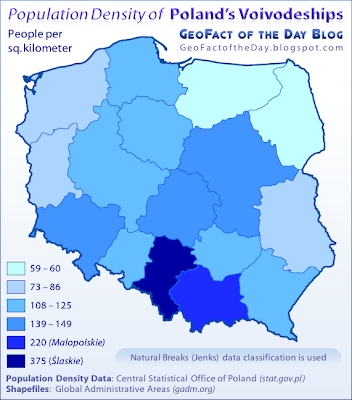
The map I made below features the population densities of Poland's voivodeships, or provinces. Visit my Poland voivodeships post for a map labeled with the names of the voivodeships. The unit of measurement on this map is people per square kilometer. Ślaskie has the highest population density, with 375 people per square kilometer. The next highest population density is 220, belonging to Malopolskie. Three provinces - Dolnoślaskie, Łódzkie (Lodz), and Mazowieckie (the location of Poland's capital, Warsaw) are in the third highest class (139-149) on my map. With the most provinces, the 108-125 class has the following six: Kujawsko-Pomorskie, Opolskie (Opole), Podkarpackie, Pomorskie, Świetokrzyskie, and Wielkopolskie. Click on the map to enlarge it! The voivodeships of Lubelskie in East Poland and Lubuskie and Zachodnio-Pomorskie (West Pomerania) in West Poland are in the second smallest class (73-86). Finally, the provinces of Podlaskie and Warminsko-Mazurskie in Northeast Poland have 59 and 60 people per square mile, according to the Central Statistical Office of Poland data (year 2012) that was used.
The Eastern European country of POLAND has sixteen provinces, which are called voivodeships in the Polish language. Mazowieckie is the voivodeship where Poland's capital, Warsaw, is located. Mazowieckie, in East-Central Poland, is the largest voivodeship, while Opolskie in Southern Poland is the smallest. I made the map below using data from www.gadm.org (Global Administrative Areas). Click on the map to enlarge it!
Located in northeastern POLAND, Jezioro Śniardwy is the largest lake of Poland. It is located in the southeastern part of the WARMIŃSKO-MAZURSKIE (Warmian-Masurian) province and is 50 miles east of Olsztyn, the province's capital. Jezioro Niegocin and Jezioro Mamry is north of the lake. Communities that surround Jezioro Śniardwy include Orzysz, Pisz, and Ruciane-Nida. The city of Ełk is about 25 miles east of the lake.

Click here to enlarge the map in a new window. This map is available as a wall map courtesy of Eric Olason at Maps.com.
 In existence for over 1,000 years, POLAND is located in Central Europe. Poland borders six countries and one territory (from west going counterclockwise): Germany, Czech Republic, Slovakia, Ukraine, Belarus, Lithuania, and Kaliningrad (a small exclave that is part of Russia). Poland has 16 provinces called voivodeships, which are featured in this GeoFact of the Day Blog post containing a map. Two voivodeships in Southern Poland - Malopolskie and Ślaskie - have the highest population densities in the country. You can find out more details about Poland's population density with this post. The capital and most-populated city of Poland is Warsaw (Warszawa). The currency is the Złoty, and the ISO 4217 currency code is PLN.
Blog Content
● The author of this GeoFact of the Day Blog creates and curates original, authentic content and posts information based on established facts. Blog posts are not generated by artificial intelligence (AI) but published by the author.
● Content and image graphics from other sources are properly credited. Many geography facts are well-established and therefore do not belong to any one source, but occasionally a fact requires attribution/credit if it is unique and hard-to-find — for example, facts found from specific cultural, anthropological, geological, and scientific (etc.) research.
● I do not copy and paste from other websites. Therefore, all posts are original but may sometimes include information, links, and/or images from credited external sources. To use a GeoFact of the Day Blog image for your website or project, write a comment below a post — then I may approve your request.
● Feel free to offer comments, suggestions, and compliments on any post or page! You can be anonymous. Spam comments with non-relevant links will be deleted.
● Thanks for your loyal readership on the educational and reliable GeoFact of the Day Blog, in existence since 2008!


